Trax & Trails - Case Studies
Case Study 1
Needs 
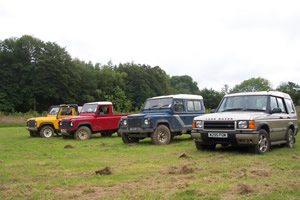
A government organisation had 60 people in a unit. Within the unit there
were four vehicle types and varying driver skill and experience levels. The
vehicles ranged from short wheel base Japanese 4x4's through pick-up and
double cab's to long wheel base Land Rovers.
There were several issues than needed addressing;
- Re-affirmation of 4wd best practice and assessment for management purposes
as each driver had differing levels of experience, skills and attitude,
- Experience of all vehicles for every team member as a driver could be
driving any one of the types,
- overcoming tyre prejudice due to a head office decision to use All-Terrain
tyres rather than Mud tyres,
- Provide Adequate Training under HSE requirements.
Training
Our package consisted of a days training starting with a session on each
4x4's on and off-road attributes, strengths and weaknesses, daily
maintenance points and transition from off-road to on. Then followed
practice of safety routines, driving each vehicle types in conditions
similar to that the delegates normally dealt with and finally a hand out for
future reference.
Outcomes.
Each driver gained experience of every vehicle type, increased confidence in
the new tyre arrangement, a refreshed best practice and gentle training
where it was needed.
Management got feedback on each driver and issues raised were of the drivers
not getting access to the vehicle hand books and the new tyre selection
being possibly in-appropriate for the off-road needs causing jobs to take
significantly longer due to concern about getting stuck.
Conclusions
Every driver needed access to the vehicle handbook to see how to operate
them correctly.
Tyre selection needed revisiting as the decision was taking without adequate
consideration for the full job needs. Although drivers were satisfied with
the All-Terrain tyres, the concerns remained as to ability in many of the
job requirements and there was still significant resistance to taking
vehicles onto many sites.
Certain drivers needed better supervision and additional training to resolve
attitude and safety concerns.
Drivers were more confident in the abilities of each vehicle type.
Case Study 2
Needs
A power cable maintenance company found they were having a significant
number of off-road accidents. Investigation revealed that these accidents
were caused by driver error and vehicle problems.
Each work unit consisted of two or more vehicles with at least one towing a
fully laden plant trailer. One was a Toyota Hilux pickup and a long wheel
base Land Rover which due to capacity did towing duties.
The needs were to review off-road driving practice, route assessment and
planning, compare the differences in each type of 4x4 and to work on
identifying and resolving the most likely causes of the accidents.
Training
We created a day session with more emphasis on multiple vehicle groups,
covered theory of transmission types and suspension design as the two
vehicles had different systems, tyre choice and basic daily maintenance
checks. This was then followed by covering the off-road driving techniques
as per Borda 1.
Outcomes
The accidents seemed to be caused by a combination of driver error and
vehicle specification faults. The drivers all identified the Hilux as being
the better 4wd vehicle "because it doesn't get stuck/fall over as often as
the Land Rover". There were three obvious reasons for this.
1) the Hilux had Mud tyres and the LR had road biased tread All-Terrains,
despite coming from the same supplier on the same contract.
2) The Land Rover was fully laden with people and equipment and was also
pulling a fully laden trailer giving a total train weight in excess of
published safe off-road maxima.
3) The routes negotiated were inappropriate for the vehicles as specified.
Management was notified of these findings and individual performance.
Conclusions
The one person who should have been required to attend this course didn't.
Often the routes negotiated were inappropriate, or negotiated without
consideration for changes in the weather.
Each vehicle needed to be on proper mud tyres and the excessive weight of
the total train needed to be split better between the available vehicles.
The vehicle contract needed to be revisited to ensure appropriate tyres for
both vehicle types.